📦 1kg Coffee roaster
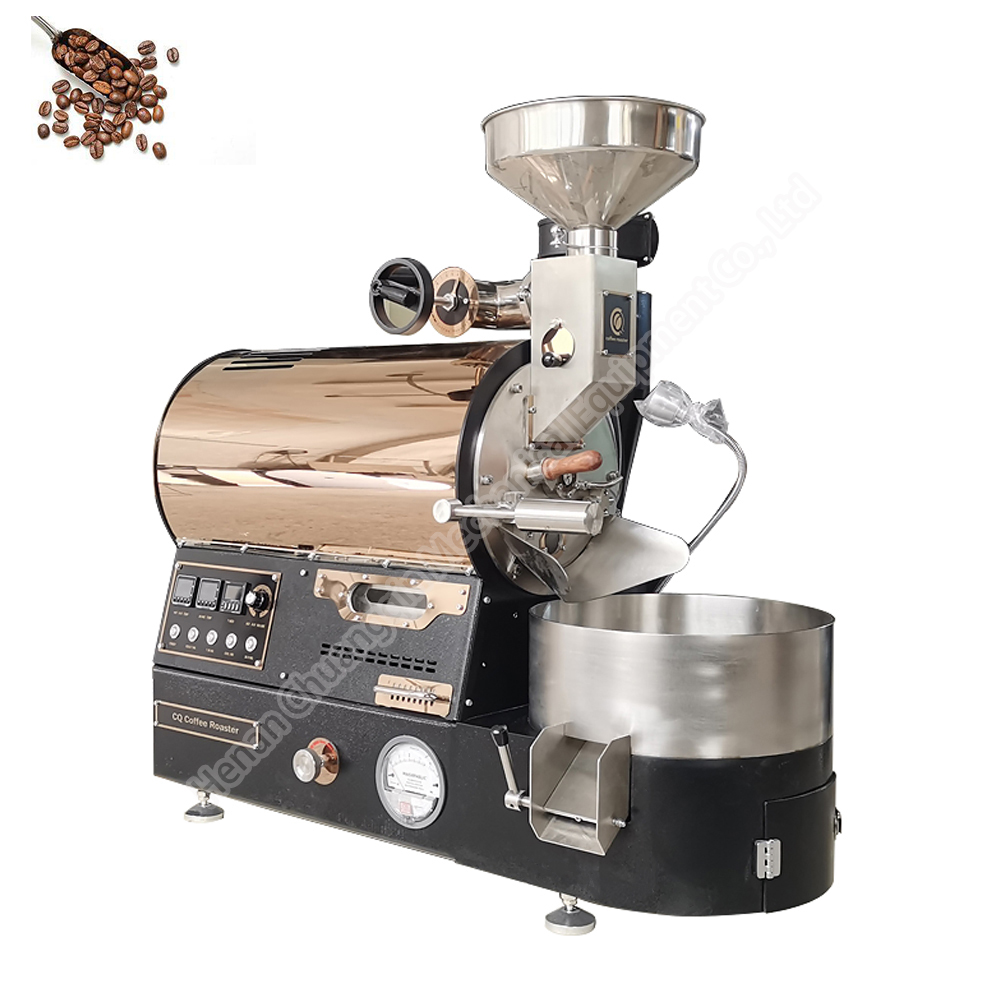
1KG Electric Coffee Roasters Coffee Roasting Machine
Model: CQ-1KG
Designed specifically for specialty coffee enthusiasts and micro-roasteries, this 1kg coffee roaster combines high performance, exceptional stability, and intelligent operation—making it the ideal choice for high-quality, small-batch roasting.
Best For
Technical Specifications
| Model | CQ-1kg Electric Coffee Roaster |
| Batch Capacity | 0.5kg - 1.5kg |
| Average Roasting Time | 10-12minutes |
| Production | 4kg/hr , 32kg/day |
| Voltage | Single Phase 220V/110V, 50/60Hz |
| Roaster Power | Electric :4220 W |
| Roaster Dimensions | 960*630*920mm |
| Roaster Weight | 125kg |
| Package Dimensions | 1200*1050*820mm |
| Package Weight | 165kg |
| Drum Construction | 304 Stainless steel/carbon steel/cast iron |
| Heating Source | Electric |
| Body Color | Black / White/ Red/ Purple |
| Housing cover color | Rose Gold / Black /Silver |
| Data Logger | Record roasting curve (USB or Bluetooth) |
Product Details
Technical Selection
Key parameters for matching this machine to your production. Send us your product to freeze, daily output and power supply and our engineers will confirm the right configuration.
Roaster Power
Electric :4220 W
Roaster Weight
125kg
Roaster Dimensions
960*630*920mm
Not sure this model fits? Tell us the product to freeze and your daily output in kg — we will confirm the matching capacity, tray layout and voltage.
Check with an engineerKey Advantages
Key Advantages
1. More Balanced Flavor Profile:
Conductive heat from the drum enhances sweetness and body, while convective hot air improves clarity and uniformity—ideal for single-origin beans, espresso blends, and a wide range of roast levels.
2. Superior Heat Uniformity and Batch Consistency:
Hot air effectively removes moisture and smoke from the drum, minimizing localized overheating and the accumulation of chaff, ensuring a consistent roast from the bean surface to the core.
3. Intuitive Push-Button Controls:
Parameters such as heat intensity, airflow (damper), and roast time are adjusted via simple, intuitive buttons—making it easy for café staff, roasting students, and small-scale producers to achieve consistent results.
4. 1kg Small-Batch Capacity for Versatile Use:
Perfect for in-store roasting, sample profiling, new product testing, small-batch custom production, and early-stage business operations, all while keeping the cost of experimentation low.
5. Efficient Smoke and Chaff Management:
Applications
📍 In-Store Roasting
Independent coffee shops, community cafés, and roasteries roast beans on-site to ensure maximum freshness and create a unique brand identity. A 1kg electric roaster requires no gas lines—simply plug it into a standard commercial power outlet. With USB connectivity and Artisan software for data logging, it lowers the barrier to entry while handling in-store brewing, retail sales, and small-scale wholesale.
📍 Sample Development & R&D
Roasting facilities, coffee brands, and green bean traders use these machines to test new beans and verify roast profiles before full-scale production. The 1kg capacity is ideal for small-batch sampling; electric PID temperature control and multi-point thermal monitoring allow for precise adjustments to heat, airflow, and drum speed.
📍 Training & Education
Coffee academies, internal staff training programs, and roasting workshops require equipment that is both safe and suitable for repeated demonstrations. Electric heating eliminates open flames and the risk of gas leaks. Features like observation windows, sampling triers, and data logging help students understand the relationship between bean color, temperature, airflow, and the cooling process.
📍 Micro-Brand Startups
Emerging roasting brands, online coffee shops, and community-based micro-roasteries can launch with small-batch sales. A 1kg batch size makes it easy to manage inventory and "resting" (degassing) periods, allowing for production based on actual orders—minimizing the risk of excess green bean stock and flavor inconsistency.
📍 Value-Added Retail (Hybrid Stores)
Establishments such as liquor stores, bookstores, bakeries, dessert shops, or outdoor/camping-themed stores can integrate a coffee experience. The compact footprint and minimal requirements for exhaust ducting make it easy to install. On-site roasting creates an inviting aroma and a visual spectacle, encouraging customers to stay longer, engage more, and make additional purchases.
📍 Pop-ups & Markets
Ideal for weekend markets, mall pop-ups, brand events, or outdoor camping coffee stations that require flexible, mobile setups. 1kg electric roasters typically run on standard power, and some models offer air purification or low-emission options—making them far better suited for temporary venues and indoor events than gas-powered roasters.
📍 Green Bean Trading & Supply Chain
Green bean traders, importers, and origin cooperatives can showcase the potential of their beans during trade shows or client visits. Roasting small batches on-site allows for an immediate demonstration of distinct flavor profiles.
📍 Chain Store Pilot Programs
Chain coffee brands are testing in-house roasting at select locations to evaluate staffing requirements and production workflows. A 1kg-capacity roaster can serve as a pilot unit to assess the impact of in-house roasting on gross margins, customer repeat rates, staff training, and supply chain logistics, helping the brand decide whether to scale up to higher-capacity equipment.
📍 Content creation for e-commerce: Coffee influencers, review channels, and brand livestreaming studios require consistent, reproducible roasting footage. Electric roasters offer parameters that are easier to record—such as roast curves, temperatures, timing, and bean development stages—facilitating the creation of standardized content and enabling direct, side-by-side comparisons.
📍 Laboratory and quality control: Food science laboratories, university training programs, and corporate R&D centers use these machines to test flavor profiles, moisture content, and roast levels. With their superior temperature stability, electric roasters are ideal for process validation and small-scale experimental trials.
Similar Models in This Category
This model is unique in its series — here are similar models from the same category.
| ☑ | Model | Model | Batch Capacity | Average Roasting Time | Production | Voltage | Inquire |
|---|---|---|---|---|---|---|---|
| CQ-1KGThis model | CQ-1kg Electric Coffee Roaster | 0.5kg - 1.5kg★ | 10-12minutes | 4kg/hr , 32kg/day | Single Phase 220V/110V, 50/60Hz | Get a Quote | |
| CQ-1KG | CQ-1kg Gas Coffee Roaster | 0.5kg - 1.5kg | 10-12minutes | 4kg/hr , 32kg/day | Single Phase 220V/110V, 50/60Hz | Get a Quote |
Compare 2–3 models? Tick the boxes and send them together — we will quote each one for you.
Tip: select multiple models and click “Inquire All” — the selected models are added to the quote form automatically, so you get a faster quotation.
Not sure which model fits your project? Send us your working pressure and air demand — our engineers will recommend the right one.
Main Components
- Roasting Drum
- Drum Motor and Speed Control Mechanism
- Electric Heating Elements
- Hot Air Circulation Fan
- Heating Chamber / Hot Air Distribution System
- Thermostat / PID Controller
- Temperature Sensors (Bean Temperature - BT, Environmental Temperature - ET)
- Timer
- Hopper / Bean Inlet
- Discharge Door / Bean Unloading Mechanism
Working Principle
Workflow 1. Preheating Phase: Upon startup, the heating system preheats the roasting drum to ensure the machine reaches a stable operating temperature. Once preheating is complete, the green beans can be loaded. 2. Loading and Temperature Rise: Approximately 1kg of green coffee beans is loaded into the roasting drum. As the drum rotates, the beans are tumbled, ensuring even heat distribution. 3. Dehydration and Flavor Development: Moisture on the surface of the green beans gradually evaporates, and the color shifts from green to yellow. This is followed by the Maillard reaction and caramelization, which develop flavor notes such as nuttiness, caramel, and floral or fruity aromas. 4. First Crack and Determining the End of Roasting: When the bean temperature reaches approximately 180–195°C, the coffee beans undergo the "first crack." The operator determines the optimal time to discharge the beans by observing their color through the viewing window, listening for the cracking sounds, and monitoring the temperature/time display on the control panel. 5. Cooling and Stabilization: Once the desired roast level is achieved, the beans are discharged into a cooling tray. A cooling fan rapidly removes residual heat, halting the roasting process and preventing the beans from roasting any further.
Detailed Features
- ▸With a rated capacity of approximately 1kg per batch, this roaster is ideal for small-batch testing, in-store roasting, or sample development.
- ▸It utilizes electric heating elements—eliminating open flames—which ensures safer installation and operation.
- ▸As it requires no gas lines or cylinders, it is well-suited for environments where open flames are restricted, such as retail shops, studios, shopping malls, and apartments.
- ▸The roasting process generates no combustion-related water vapor, resulting in more stable ambient humidity.
- ▸Heating response is generally slower than that of gas-powered models; temperature curves rely heavily on precise power control and effective preheating management.
- ▸Equipped with a PID temperature controller, it allows for the setting of target temperatures, power ratios, and airflow/heat parameters.
- ▸Includes sensors for monitoring bean temperature, ambient temperature, and/or exhaust air temperature.
- ▸The roasting drum is constructed from 304 stainless steel.
- ▸The drum motor features adjustable speed, allowing for control over bean tumbling, suspension time, and heat exposure.
- ▸The hot-air circulation fan allows for adjustments to the convection ratio, which influences the rate of temperature rise and the final flavor profile.
Packaging & Shipping
The unit is packed for export in a fumigation-free plywood crate. It is wrapped in PE film for moisture protection, with EPE foam corner protectors for cushioning, and secured to a wooden base with bolts—ensuring robust protection for critical components such as the glass viewing window, control panel, and fan. The standard crate dimensions are approximately 1200 × 820 × 1050 mm, with a gross weight of about 165 kg. We support FOB, CIF, and DDP shipping terms and can coordinate with your designated freight forwarder. Each shipment includes a packing list, invoice, certificate of origin, CE certificate, and user manuals in both Chinese and English. Before leaving the factory, every unit undergoes a no-load test run, with photographic records kept, ensuring the equipment is ready for immediate use upon arrival.
After-Sales Service
24 months warranty, 24/7 remote support, spare parts in stock
Frequently Asked Questions
What batch size and output does the CQ-1KG coffee roaster handle?+
The CQ-1KG roasts batches from 0.5kg to 1.5kg, with an average roasting time of 10-12 minutes and production of 4kg/hr or 32kg/day. This range supports small-batch testing, in-store roasting and sample development.
What power source does the CQ-1KG use?+
The CQ-1KG runs on single-phase 220V/110V at 50/60Hz with 4220W electric heating. Electric heating elements eliminate open flames, so no gas lines or cylinders are required.
What drum construction and data logging does the CQ-1KG offer?+
The CQ-1KG drum is available in 304 stainless steel, carbon steel or cast iron, and a data logger records the roasting curve via USB or Bluetooth. Heat intensity, airflow damper and roast time are adjusted with push-button controls.
Where can the CQ-1KG electric roaster be installed?+
The CQ-1KG is suited to retail shops, studios, shopping malls and apartments because electric heating requires no open flames. The roasting process generates no combustion-related water vapor, giving more stable ambient humidity.
What are the dimensions and weight of the CQ-1KG?+
The CQ-1KG roaster measures 960*630*920mm and weighs 125kg. It is packed in a crate of 1200*1050*820mm with a gross weight of 165kg.
How is the CQ-1KG packaged for shipping?+
The CQ-1KG is packed for export in a fumigation-free plywood crate, wrapped in PE film with EPE foam corner protectors and bolted to a wooden base. The standard crate measures approximately 1200 × 820 × 1050 mm with a gross weight of 165kg.
What after-sales support comes with the CQ-1KG?+
The CQ-1KG carries a 24 months warranty with 24/7 remote support and spare parts in stock. Support covers the roaster's control panel, fan and glass viewing window.
What body and housing colors are available for the CQ-1KG?+
The CQ-1KG body is available in black, white, red or purple, with a housing cover in rose gold, black or silver. The roaster is offered as an electric model with 4220W power.
Related Insights
Is This Rig Right for My Project?
Answer seven questions about your hole, depth and rock — get a matched rig, compressor, hammer, bit and rod.
Need Technical Support?
Request information and get a quote from our engineers.